Set a growth ambition and Merchmix Recommends rebuilds your entire retail plan against it, then tells you how confident it is that the number holds and what has to go right for it to land.

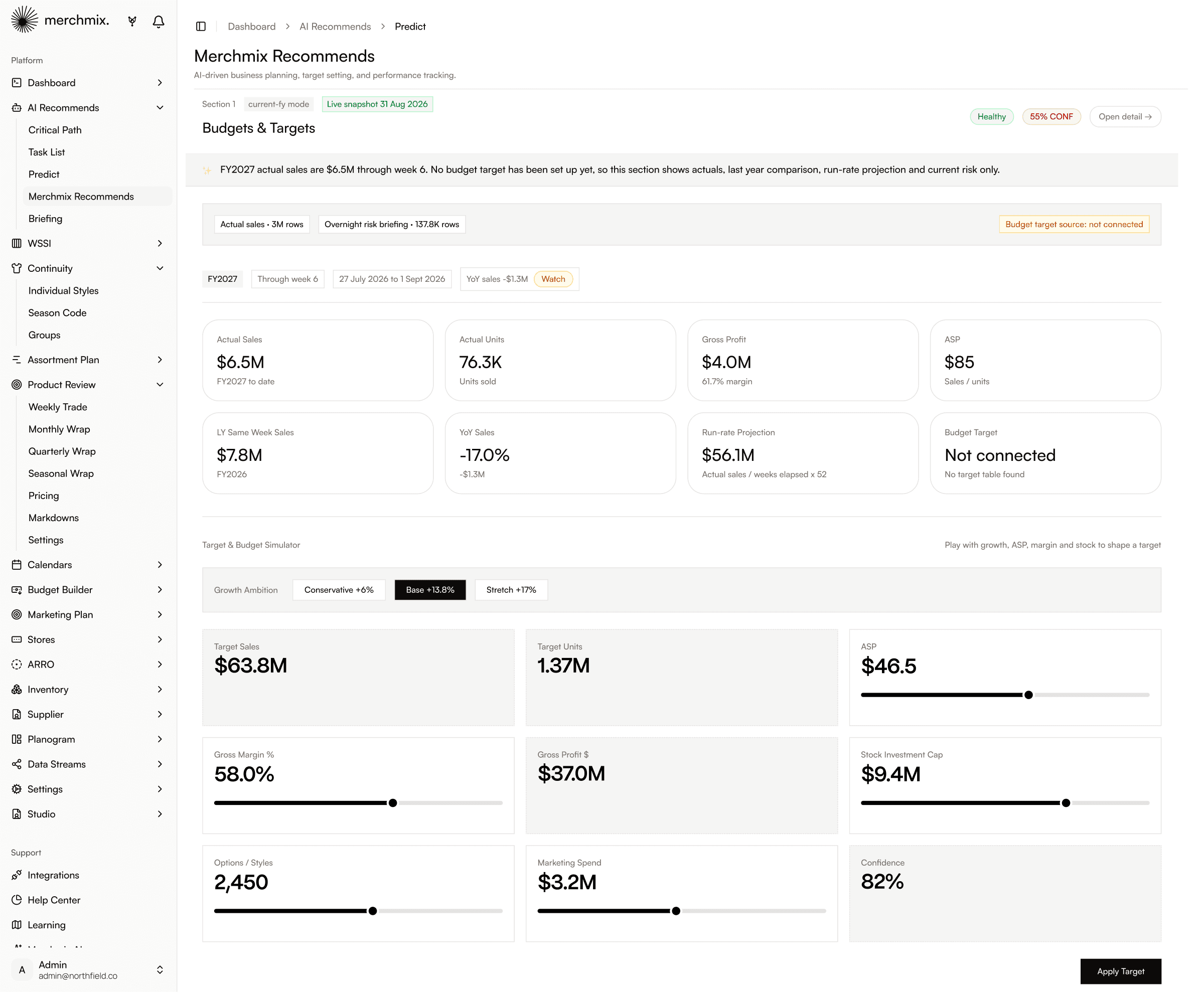
Target and budget simulator
Choose conservative, base or stretch, then shape it with the levers a retail business actually controls. Average selling price, gross margin, stock investment cap, option count and marketing spend.
Target sales, units and gross profit recalculate as you move each one. Push the margin and watch the stock cap fight it. Add options and watch confidence fall. It is the conversation you would normally have across four meetings and three spreadsheets, held in about ninety seconds.
When the shape is right, apply the target. Everything downstream rebuilds against it.
Confidence
Merchmix scores its own confidence in the target you have set, and tells you what that score rests on. Reachable but execution-dependent. Confidence falls below seventy-five per cent if supplier reliability slips or markdown discipline goes.
That score follows the plan everywhere. Every one of the twenty-four sections carries its own confidence figure and the basis behind it, so a section running at ninety-four per cent and one running at fifty look different on the page, and you know which part of the plan is carrying the risk.
When your board asks how sure you are, you are not guessing, and you are not quoting a single number that hides the parts you are least certain about.
Most tools tell you what to do. This one tells you how likely it is to work.
The plan behind the target
Apply the target and every part of the business reprices against it. Stock, intake and open to buy. Range, category and assortment. Channel, store and location. Audience, loyalty and demand. Marketing and growth activity.
Twenty-four sections, each one showing what your ambition means for that part of the business, what is already at risk, and what would have to change for the number to land. Each section opens with a written read of what it found, not a chart you have to interpret.
This is the difference between announcing a number to the board and knowing how your merchandising, buying and marketing teams are going to hit it.
Evidence
Every section shows its own working. Which systems it read, how many sources, how many rows, which briefing it drew from, and how confident it is in what it found. Three kinds of evidence sit behind the plan.
Live trading data straight from your systems, read at row level rather than summarised. Stock position, sales, margin, cover and supplier exposure, down to the individual style.
Stores, online and concession, alongside customer behaviour, loyalty, demand signals and campaign performance across every place you sell.
Competitor assortments and pricing, plus the inflation, currency, supply chain and competitive pressure assumptions the whole plan rests on.
You can see all of it. So can your CFO, which is usually the harder audience.

Scenario comparison
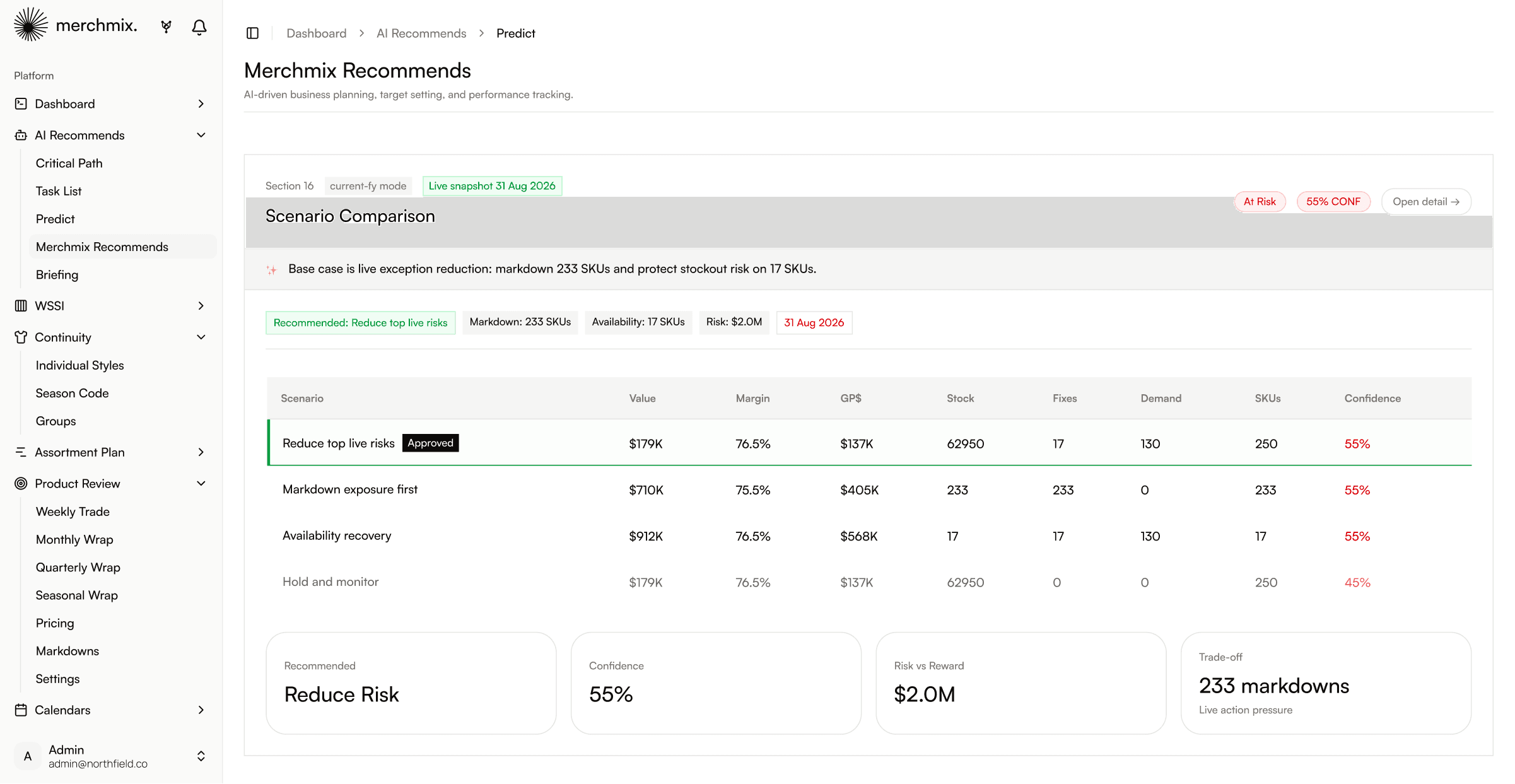
Reduce your biggest risks first. Tackle markdown exposure. Recover availability. Hold and monitor.
Each route is priced against value, margin, gross profit, stock, demand and confidence, so the trade-off is visible rather than argued. Protecting availability might return more but move less stock. Attacking markdown might move more stock at a worse margin. You can see both before anyone commits.
Merchmix recommends one route. You approve one. They do not have to be the same, and the record shows when they were not.

Risk and guardrails
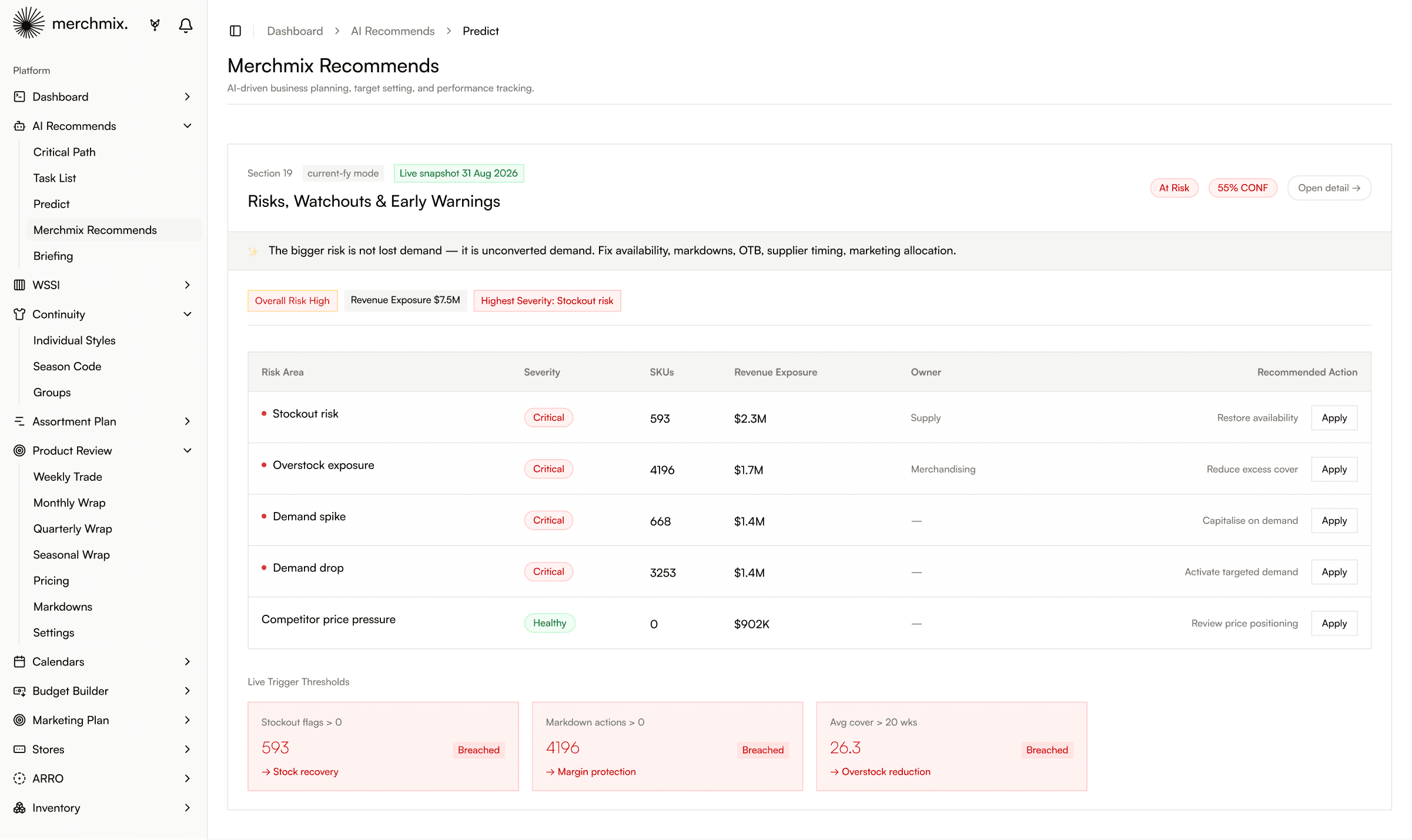
Every risk is scored for severity, sized in revenue, tied to the indicator that would signal it, and assigned to the person who owns it. Margin risk to the CFO. Availability to the COO. Competitor pressure to pricing.
Set the thresholds yourself. Availability below a floor. Markdown above a ceiling. Return on ad spend under target. Each one shows its live state, so a breach is a fact on the page rather than something someone raises three weeks later.
The point is not to predict every risk. It is to make sure the ones you already know about have an owner and a trigger, so nobody finds out at the quarterly review.

Decision record and board pack
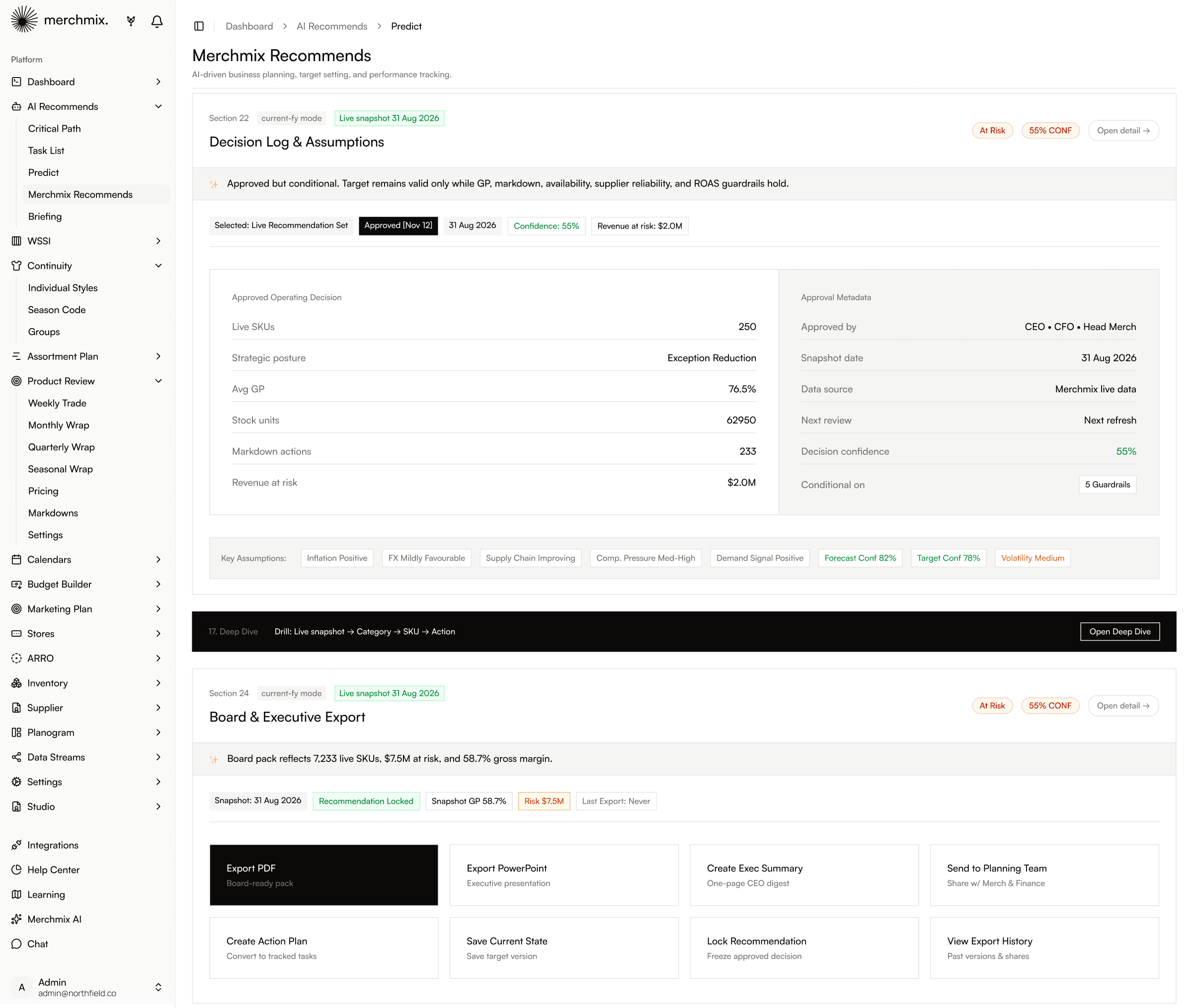
Approvals are recorded against the people who gave them, with the guardrails the decision depends on and the assumptions in force at the time. Inflation, currency, supply chain, competitive pressure, forecast confidence.
When conditions change, you can see exactly which assumption moved and whether the decision still stands. That turns the quarterly argument about who agreed to what into a lookup.
Then take it to the board. A board-ready pack, an executive presentation, a one-page summary, or straight into your planning team as tracked actions, with the export contents chosen before it goes.
Tracking and accountability
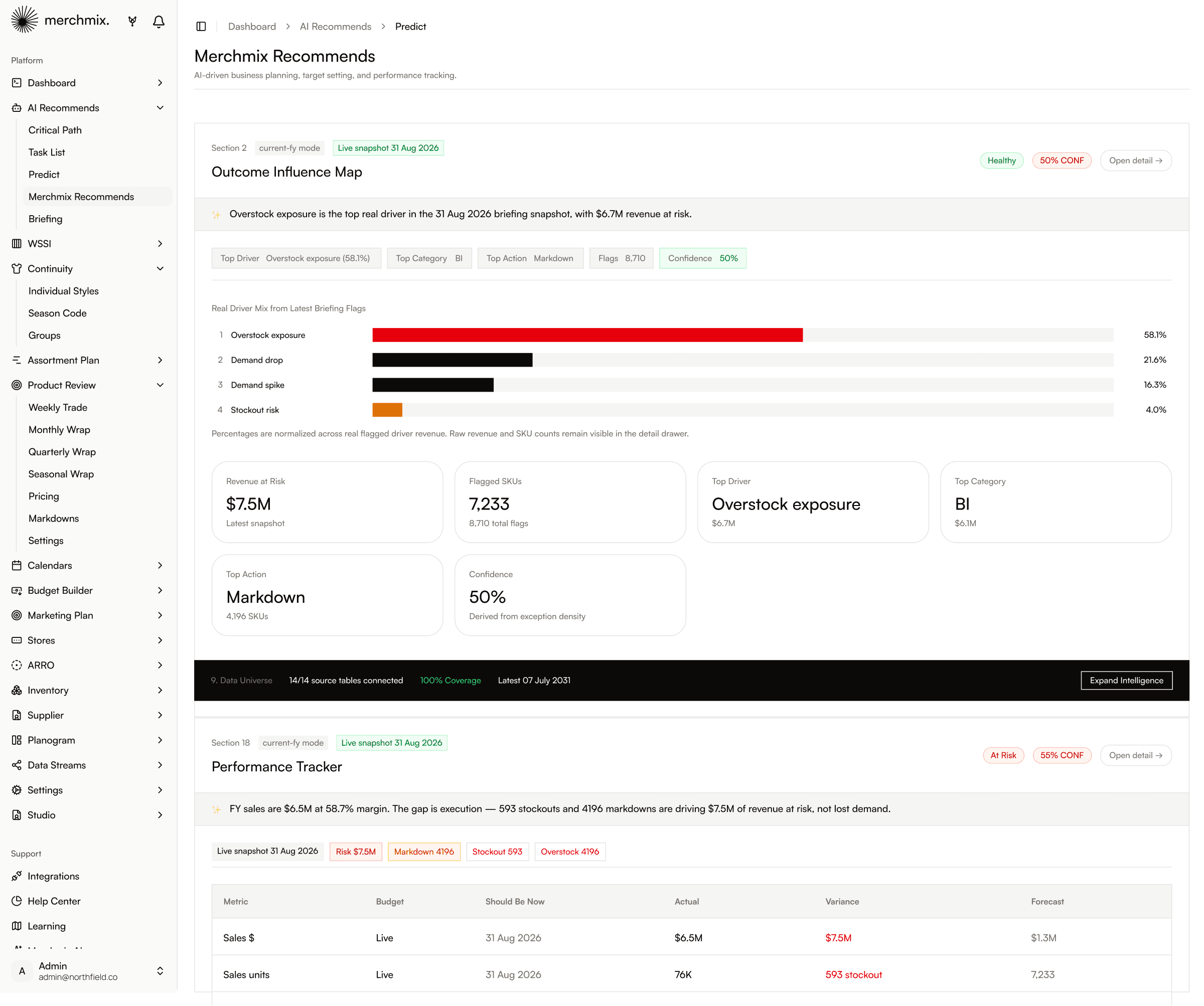
The plan becomes an execution timeline, and performance tracks against the target every week. Where the work can be prepared for you, Merchmix AI agents build it and hold it for approval.
An owner, a due date, an expected impact and the dependency it is waiting on, laid out across twelve weeks so the sequence is visible rather than assumed.
Performance tracks against the target week by week. When something shifts you can drill into it by category, by store, by channel or by risk attribution, rather than arguing about the cause.
Proof of concept
We connect your systems, load your trading history and let you set a growth ambition against your real numbers. Six weeks, your data, your retail estate. Not a sandbox and not a demo dataset.
At the end you will know what your plan actually depends on, how confident you can be in it, and which parts of the business are carrying the risk.
Merchmix Recommends does not decide how fast you grow. It tells you what that decision costs, what it depends on, and whether it holds.