Retail pricing, explained
What is a retail markdown?
A markdown is a permanent reduction in a product's selling price, taken to clear stock that is not selling fast enough at its current price. It is different from a promotion, which is temporary and planned to drive sales, and it is one of the largest costs in retail that never appears on an invoice: the money is lost not when the price drops, but months earlier, when the stock was bought, allocated or held wrong.
This guide covers how markdowns differ from promotions, what a markdown really costs in margin, how timing changes the outcome, and why the best markdown is often the one you avoid.
9 min read · Updated 16 July 2026
The basics
A markdown and a promotion are opposites.
The two get blurred in conversation and should never be blurred in a plan, because they are opposite decisions.
| Markdown | Promotion | |
|---|---|---|
| Duration | Permanent. The price does not come back up | Temporary. The price returns after the event |
| Purpose | Clear stock that is not earning its space | Drive traffic and sales on stock you want more demand for |
| When it is decided | In-season, in response to trading | In advance, as part of the trading calendar |
| What it signals | The buy, the price or the distribution was wrong | Nothing is wrong. It is a planned investment |
A promotion is planned into the season in the MFP (WSSI) before it happens. A markdown is a correction. The confusion matters because businesses that report the two together cannot see which part of their discount spend is strategy and which part is paying for mistakes.
The causes
Markdowns trace back to four roots.
Almost every markdown traces back to one of four roots.
- The buy was too big.
- The forecast said more than the market did. The most common cause and the least visible in the moment, because an overbuy looks identical to a good buy for its first six weeks.
- The trend was missed.
- The product was right last season. Fashion and seasonal categories carry this risk structurally, which is why speed into and out of trends matters more than forecast accuracy.
- The season ended.
- Some markdown is simply the calendar: swimwear in autumn has a shelf life, and clearing it is the correct decision, not a failure. The question is only how much of the buy is left when the calendar turns.
- The stock was in the wrong place.
- The units existed and the demand existed, but not in the same location or size. A line can sell out in ten stores and get marked down in thirty. This is the root cause that is least discussed and most fixable, because it is a distribution problem, not a buying one. The mechanics of fixing it live in allocation and replenishment.
See it in numbers
A markdown costs more than its depth.
The arithmetic is brutal and worth doing once with real numbers.
Take a product with an RRP of $100 and a cost of $40. At full price, every unit contributes $60 of gross profit.
| Full price | 30% markdown | 50% markdown | |
|---|---|---|---|
| Selling price | $100 | $70 | $50 |
| Cost | $40 | $40 | $40 |
| GP per unit | $60 | $30 | $10 |
| Units to earn the same GP as one full-price sale | 1 | 2 | 6 |
- $60
- GP per unit at full price
- 6 units
- To earn the same GP at 50% off
At 30% off, the discount looks moderate but half the profit is gone: the product must sell twice as fast just to stand still. At 50% off, six units earn what one used to. This is why markdown depth is a bigger decision than markdown timing gets credit for, and why a blanket 50% off event applied across a category, hot lines included, burns margin on stock that would have cleared at 30 or did not need marking down at all.
The same table explains the flip side: a markdown taken early, when 20% off genuinely moves the stock, costs a fraction of the one taken late, when only 60% off will.
Timing
Early and shallow beats late and deep.
Stock that is not selling does not become easier to sell. Its season shortens, its competition goes on sale around it, and its space and cash could be working in a product that earns. Meanwhile the signals were available weeks earlier: sell-through below plan, weeks of cover climbing, rate of sale flat while newer lines accelerate. All of them live in the WSSI, which is why markdown decisions made without it are consistently late.
- Check distribution first.
- Is the line slow everywhere, or slow in aggregate and starved in the stores where it sells? If demand exists somewhere, a transfer or reallocation protects full price and no markdown is needed yet.
- Model the depth, do not guess it.
- The right first markdown is the shallowest one that actually changes the rate of sale. Modelling a 20, 30 and 40% bracket against projected sales, remaining stock and gross profit turns the decision from a feeling into a comparison.
- Take it, then watch it.
- A markdown that does not lift the rate of sale within a couple of weeks was the wrong depth, and the next cut needs the same modelling, not a reflex extra 10%.
- Feed it back.
- Every markdown is information about the buy. A category that keeps needing depth is telling you something about its option count, its sizing or its allocation, and next season's plan should hear it.
Where it breaks
Spreadsheets decide markdowns blind.
Almost every retailer starts here, and for a while it is completely fine. It stops being fine for reasons that have nothing to do with how good the planner is.
- The decision is made blind.
- A clearance list in a spreadsheet shows what stock is old. It does not show projected gross profit at each candidate depth, which stores still sell the line, or whether the open to buy consequences have been counted. So depth gets decided by habit: last year's percentage, on this year's stock.
- Everything gets the same cut.
- Without item-level modelling, markdowns are taken at category level, and the blanket percentage overpays on stock that needed less and underpays on stock that needed more.
- There is no sign-off trail.
- Prices change, and six weeks later nobody can reconstruct who approved what, at what depth, against what forecast. When the season is reviewed, the markdown line is a number with no memory.
- The markdown and the plan never meet.
- The WSSI has a markdown budget. The clearance activity happens somewhere else. The two reconcile at month end, which is the most expensive possible time to find out they disagreed.
In merchmix
In merchmix, markdown is a modelled decision.
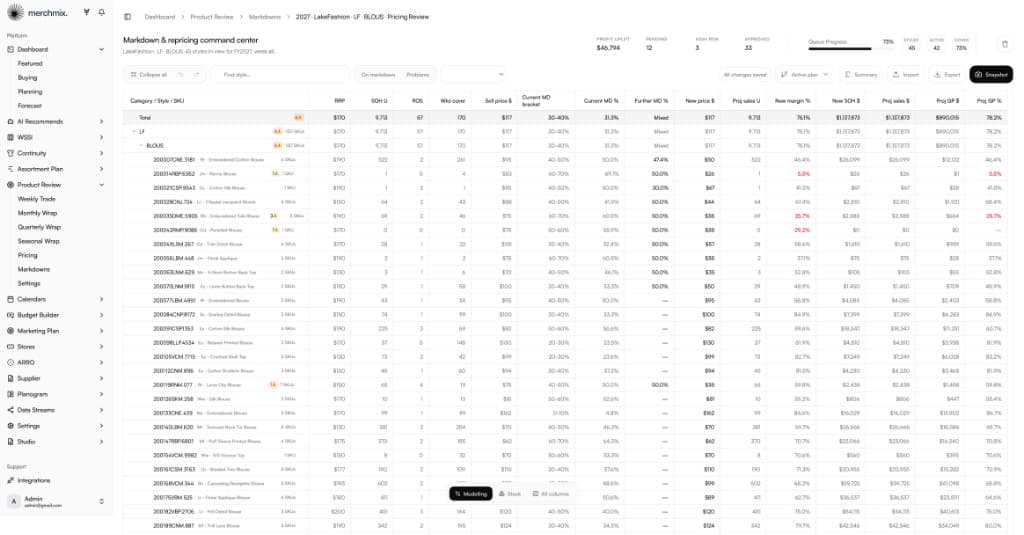
In merchmix, markdown is a modelled decision inside the trading cycle, not a separate clearance exercise. The markdown and repricing workspace sits inside core's product review, alongside weekly and monthly trade, reading the same live numbers as the rest of the platform.
The opportunity board surfaces where profit is at stake: low-margin styles, aged stock, high exposure and critical cover, ranked by estimated gross profit lift so the biggest decisions get attention first. Each review is modelled before it is actioned: at style and SKU level, merchants simulate discount depths and see the projected impact on sales units, margin, stock value and gross profit, with current and further markdown brackets side by side so the cost of going deeper is always explicit. yukti, the agent, provides the rationale alongside each pricing recommendation, and the merchant keeps the pen.
Decisions carry governance. Proposals sit pending until validated, then export as clean pricing sheets for sign-off, with the decision context preserved. And because markdown lives in the same loop as allocation and replenishment, slow stock is checked as a rebalancing candidate before it becomes a clearance one. Markdown stays the last lever, applied with precision when it is the right one.
Markdown stays the last lever.
Questions, answered.
What is a markdown in retail?
A permanent reduction in a product's selling price, taken to clear stock that is not selling fast enough at its current price. Unlike a promotion, the price does not return to its original level.
What is the difference between a markdown and a promotion?
A promotion is temporary, planned in advance, and used to drive demand. A markdown is permanent, decided in-season, and used to correct a position: stock that the market has priced lower than you did.
How do you calculate markdown percentage?
Markdown spend as a share of sales: the total value given away in price reductions, divided by total sales for the period. A markdown percentage climbing season on season is one of the clearest signals of a planning or distribution problem upstream.
What is a markdown budget?
The amount of markdown spend planned into the season, usually as a line in the WSSI. Some markdown is normal and planned, particularly at season end. The budget exists so the unplanned part is visible.
When should you take the first markdown?
When the sell-through and cover signals say the line will not clear at full price within its season, and after checking whether redistribution would fix it instead. Early and shallow consistently beats late and deep, because the shallowest cut that changes the rate of sale is the least expensive one available, and it gets more expensive with every week of waiting.
How deep should a markdown be?
Deep enough to change the rate of sale and no deeper. The honest answer is that it should be modelled, not guessed: comparing projected units, sales and gross profit at each depth for the specific stock in question. A blanket percentage across a category is almost always overpaying somewhere.
Can markdowns be avoided?
Some cannot: seasons end and trends miss. But the share caused by stock sitting in the wrong stores or sizes is avoidable, because it is a distribution problem. Rebalancing stock to where it sells, early enough to matter, converts would-be markdown units into full-price sales.
What is the difference between a markdown and a write-off?
A markdown reduces the price to sell the stock. A write-off removes the stock's value from the books entirely, when it cannot be sold at any workable price. A write-off is where stock ends up when markdowns start too late.
Fewer markdowns, better ones.
Let us show you how merchmix keeps markdown the last lever, not the first. 1-hour demo with sales and product.