Retail operations, explained
What is allocation and replenishment in retail?
Allocation and replenishment planning is how a retailer decides how much of each line every store gets when it lands, and how each store is topped up as it sells. Allocation and replenishment are the two decisions that put retail stock in the right place. Allocation decides where new stock goes first: how many units of a new line each store and channel receives when it lands. Replenishment keeps it there: the ongoing top-up that reacts to what each location actually sells. Together they are shortened to A&R, and they are where a good buy gets converted into sales, or quietly wasted.
This guide covers what each one does, how the two work together, a worked example across a store estate, and why rule-based A&R falls behind the way stores actually trade.
10 min read · Updated 23 October 2026
The basics
Allocation pushes, replenishment pulls.
They answer two different questions about the same stock.
Allocation asks: this stock has just arrived, where should it start? It is a push decision, made before there is any sales history for the product, using what you know about each location: its grade, its size profile, its space, how similar products performed there before.
Replenishment asks: this stock is now selling, where should the next units go? It is a pull decision, driven by actual demand. Each location's sales draw stock out of the distribution centre at the pace that location earns it.
Replenishment runs at two levels. Store replenishment moves stock from the DC to each location as it sells. Supplier replenishment reorders stock into the DC from the vendor, which is how continuity and never-out lines are kept in supply. This page focuses on the store side; the supplier side is planned through the MFP (WSSI) and the open to buy.
| Allocation | Replenishment | |
|---|---|---|
| When it happens | At launch, and whenever new intake lands | Continuously, through the product's life |
| What drives it | Store grades, size profiles, space, history of similar lines | Actual sales, rate of sale, cover, availability |
| The direction | Push from the DC | Pull from demand |
| Getting it wrong | Stock starts in the wrong place and has to be moved or marked down | Bestsellers run dry while slow stores sit on stock |
The two are inseparable in practice. A cautious allocation relies on fast replenishment to catch up with demand. A heavy allocation leaves nothing in the DC to replenish with. Every retailer sits somewhere on that line, and where you sit should depend on your lead times and how fast you can move stock, not on habit.
The first decision
Allocation comes down to three decisions.
A typical allocation comes down to three decisions: where the stock goes, in what sizes, and how much stays back.
- Store grading.
- Stores are ranked into grades, usually by turnover in the relevant category: A stores take the most, D stores take the least. Grading by total store turnover is the common shortcut and the common mistake, because a store that is grade A overall can be grade C for swimwear. The useful grade is the one for the category being allocated. The grade sets the intent and the store's space caps it: an allocation still has to respect the location's capacity and minimum display quantities, whatever the grade says.
- Size curves.
- Within each store's quantity, the units are split across sizes. Size profiles differ by location more than most businesses expect, and a wrong curve does invisible damage: the store looks stocked, but the sizes customers there actually buy are missing, so it trades like an understocked store while reporting full.
- The hold-back.
- Almost nobody allocates 100% of a buy on day one. A share stays in the DC, commonly 20 to 40%, so replenishment has something to work with once real sales data arrives. The right hold-back depends on confidence: a repeat of a proven line can go out heavier. A new, unproven line should hold more back, because the first two weeks of trading will know more than any forecast did.
Grading and clustering are the established method, and they work. The newer development is systems that learn each store's demand pattern per category and refine the allocation continuously, rather than relying on a grade set once a season. That is where allocation is heading, and it changes the hold-back maths: the faster the system learns, the less you need to guess up front.
The ongoing decision
Replenishment runs on rate of sale.
Once a product trades, replenishment takes over. The mechanics:
- Rate of sale.
- Each location's weekly selling pace for the product, smoothed over recent weeks so one strong Saturday does not rewrite the plan.
- Cover.
- Stock on hand divided by rate of sale: how many weeks the current holding lasts at the current pace. Low cover at a fast store is the trigger to send more. High cover at a slow store is the trigger to stop sending, and possibly to pull stock back out.
- Order-up-to levels.
- Many systems replenish each location up to a target stock level, recalculated as rate of sale moves. The target has to respect pack sizes, minimum display quantities and the space the store actually has.
- Review cycle and lead time.
- Replenishment is only as fast as the loop it runs in. A weekly review with a three day lead time means a store that sells out on Monday can be dry for most of two weeks. This is why cover targets cannot be borrowed from another retailer: the right cover is a function of how fast your own loop turns. The same logic, read from the planning side, lives in the WSSI guide.
- Transfers.
- When one store is heavy, another is dry and the DC is empty, the answer is a store-to-store transfer. Most businesses do these late, as a clearance activity, when they are most valuable early, as a rebalancing one.
See it in numbers
One line, 40 stores, in numbers.
A new line lands: 2,000 units, 40 stores, and a DC. The allocation grades the estate and holds back 30%.
| Grade | Stores | Units per store | Total |
|---|---|---|---|
| A | 8 | 60 | 480 |
| B | 14 | 40 | 560 |
| C | 18 | 20 | 360 |
| Hold-back at DC | 600 | ||
| Total | 40 | 2,000 |
Two weeks in, the sales data says the forecast was wrong in both directions. The A stores are selling 12 a week each, on course to be dry inside week 5. Six of the C stores have sold almost nothing and are sitting on 15 weeks of cover.
- Week 5
- A stores dry, on current pace
- 15 weeks
- Cover in the coldest C stores
This is the moment A&R earns its keep. The 600 held back flows to the A stores, another six weeks of selling covered at their current pace. The six cold C stores stop receiving anything. And 60 units transfer out of the coldest stores into the warmest before week 6, which is 60 units that sell at full price instead of joining a markdown three months later.
Now run the same fortnight with a 100% day-one allocation and no transfers. The A stores go dry in week 5 with nothing left to send, the cold stores keep their dead stock until clearance, and the line finishes the season having sold fewer units at a worse margin, from an identical buy. Nothing about the product changed. Only the distribution did.
Where the rules break
Rule-based A&R falls behind the stores.
Most allocation and replenishment problems are not forecasting problems. They are connection problems.
- The rules are static and the stores are not.
- A grading file built at season start does not know that a store's category mix shifted, that roadworks halved its footfall, or that one location has quietly become the best swimwear store in the estate. Rules written in March run the business in August.
- Sizes fragment silently.
- A store showing healthy total stock can be missing its two best-selling sizes. Systems that replenish at style level rather than size level keep the total right and the shelf wrong.
- A&R is disconnected from the plan.
- Allocation decisions get made without seeing the WSSI, so nobody checks whether chasing a line fits inside the open-to-buy, or whether the plan already expects the category to slow. The insight sits in planning, the action sits in allocation, and the two meet in a meeting, days later.
- Transfers come too late.
- Rebalancing is treated as an end-of-season clean-up rather than an in-season lever, by which point the transfer is moving stock between two markdown events instead of preventing one.
In merchmix
In merchmix, A&R reads the same plan.
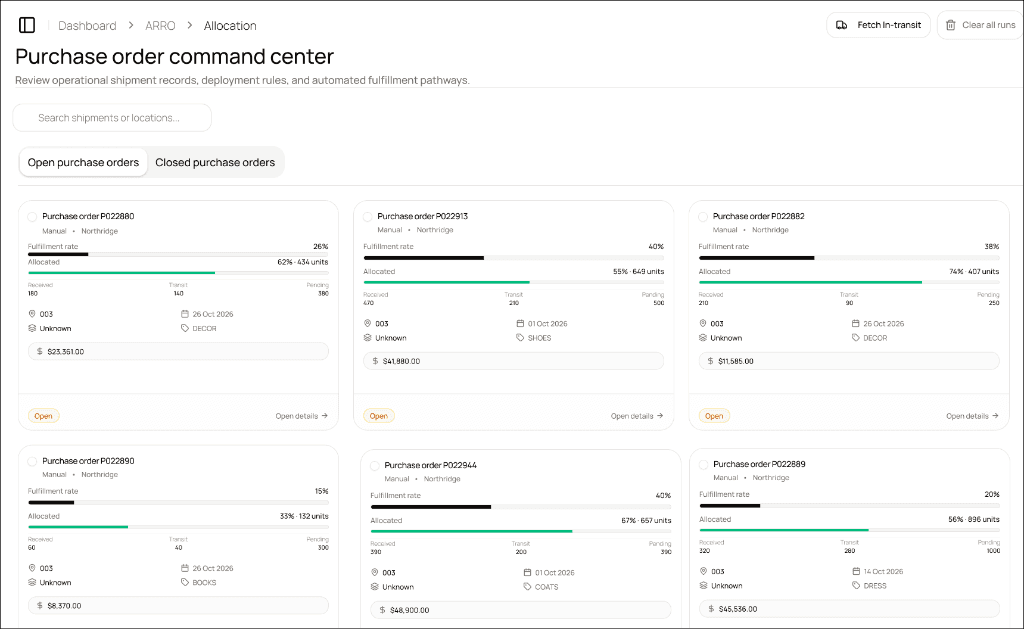
In merchmix, A&R runs inside the same connected loop as planning, so distribution decisions read the same numbers as the plan. core plus, the allocation and replenishment engine, drives stock decisions from demand, availability, cover and store-level control rather than from a static rules file.
Store grading and clustering are fully supported and category-aware, size curves are built per location from actual selling, and initial allocations respect space, minimum display and pack constraints. Within core plus, yukti, the agent, learns each store's demand pattern per category and recommends allocations at store and size level, refining as real selling data lands. Once a line trades, replenishment reads live rate of sale and cover by store and size, flags where availability risk is building, and sizes the chase against what the WSSI and open to buy can actually support. Slow stock is surfaced as a rebalancing candidate early, so transfers happen while they still protect full-price sales, and what cannot be rebalanced flows into the markdown workspace as a modelled decision rather than a surprise.
Recommendations arrive as actions to review, approve and track, not as another report: a chase, a hold, a transfer, each with the reasoning shown. Your team keeps the pen. The platform makes sure the decision reaches the DC, the store and the plan at the same time.
Good allocation keeps correcting itself.
Questions, answered.
What is allocation in retail?
Allocation is the decision of how many units of new stock each store and channel receives when the stock first arrives. It is made using store grades, size profiles, space and the history of similar products, because the product itself has no sales history yet.
What is replenishment in retail?
Replenishment is the ongoing top-up of stock based on what actually sells. It runs at two levels: store replenishment moves stock from the DC to each location as it sells, and supplier replenishment reorders stock into the DC from the vendor. Both are driven by rate of sale, weeks of cover and target stock levels, and constrained by lead times and pack sizes.
What is the difference between push and pull distribution?
Push distributes stock on a forecast made centrally, which is what an initial allocation is. Pull distributes stock in response to actual demand at each location, which is what replenishment is. Most retail lines start on push and switch to pull as sales data arrives.
What is store grading?
Ranking stores by their sales potential, usually into bands like A to D, to decide how much stock each receives. It works best done per category rather than per store, because a store's rank changes depending on what is being allocated.
What is a size curve?
The split of units across sizes for a given location or cluster. Size curves vary by location, and using one national curve for every store leaves some stores missing their best-selling sizes while appearing fully stocked in total.
How much stock should be held back from an initial allocation?
Commonly 20 to 40%, but the honest answer is that it depends on confidence and speed. Proven repeat lines can go out heavier. New lines should hold more back, because two weeks of real trading beats any pre-launch forecast, provided your replenishment loop is fast enough to act on it.
What is a stock transfer and when should you use one?
Moving stock between stores rather than from the DC. Most valuable mid-season as a rebalancing tool, moving units from stores with excess cover to stores at risk of selling out, and least valuable when left until clearance.
How does A&R connect to the WSSI?
The WSSI sets the plan for sales, stock and intake, and A&R executes the stock side of it. Cover falling in the WSSI is the signal; the chase, allocation or transfer is the action. When the two live in separate systems, the signal and the action drift apart.
Right stock, right place, while it counts.
Let us show you how merchmix keeps stock moving to where it sells.