Retail buying, explained
What is open to buy and how does it work?
Open to buy (OTB) is the money a retailer still has free to spend on stock for a period, after planned sales, markdowns, closing stock and stock already on order are allowed for. It is worked out by category and week from the MFP (WSSI): planned sales plus planned markdowns plus planned closing stock, minus opening stock, minus stock on order. It is not a budget you are handed. It is a number the plan produces, and it changes every time the plan does.
This guide covers the formula, a worked example of actually spending it, why OTB at cost and OTB at retail are different numbers, and the reason lead time decides what you can really buy.
8 min read · Updated 27 October 2026
In this guide
- Open-to-buy is a ceiling on the buy.
- Five inputs, three of them decisions.
- What you can actually buy, in numbers.
- Lead time decides what you can buy.
- OTB is one decision in two currencies.
- Most of it is already spent.
- Open-to-buy expires faster than it is rebuilt.
- In merchmix, the OTB moves with the plan.
- Questions, answered
The basics
Open-to-buy is a ceiling on the buy.
Open-to-buy answers one question: how much more can I commit to without breaking the plan.
The most common misunderstanding is that OTB is a budget handed down from finance. It is not. The budget is a target. The OTB is what falls out of the weekly plan once the target meets reality, and unlike the budget, it moves every single week.
It is a ceiling, not a target. Nobody wins for spending all of it. The number exists so that buying decisions stay tied to what the business can actually sell and hold, rather than to what looked good in a showroom.
It is usually calculated by category and by period, most often monthly. That monthly habit is where a lot of the damage happens: a number built in week one is still being spent against in week four, by which point sales, stock and deliveries have all moved and nobody has said so. Weekly is more work and it is more true.
The calculation
Five inputs, three of them decisions.
For any given period, at retail value:
OTB = planned closing stock + planned sales + planned markdowns, minus opening stock, minus stock already on order.
In plain terms: work out where you need to end up, add everything that will leave the building on the way there, then subtract what you already have and what is already coming. Whatever is left is what you can still buy.
Three of those five inputs are decisions and only two are facts. Planned closing stock, planned sales and planned markdowns are all calls somebody made. Opening stock and stock already on order are simply true. That balance is worth sitting with, because when the OTB comes back at a number nobody likes, three of the five can be argued with, and they usually are. Nudge the closing stock target, take a friendlier view of forward sales, quietly assume the markdown will be shallower, and the open-to-buy improves without a single thing changing in the business.
See it in numbers
What you can actually buy, in numbers.
Every OTB guide gives you the formula. Almost none of them cover the part that decides everything: whether you can get the stock in time to sell it.
A category is six weeks from the end of its phase, weeks 7 to 12. It has been trading well. The plan says there is 120 of open-to-buy left, at retail value in thousands of dollars. The bestseller is running at roughly 40 a week and is going to run out around week 9.
So there is 120 to spend and an obvious thing to spend it on. Here is what actually happens.
| Option | Lands | Weeks left to sell | Sales captured | Margin impact | Verdict |
|---|---|---|---|---|---|
| Reorder by sea, 8 week lead | Week 15 | 0 | 0 | None, and 120 of stock arriving after the phase is over | Dead on arrival |
| Reorder by air, 3 week lead | Week 10 | 3 | 120 | 6 points of margin gone to freight | Works, at a price |
| Buy nothing | n/a | n/a | 0 | Margin intact, cash intact | Finish clean, leave sales behind |
Look closely at the option that works. The bestseller runs out in week 9 and the air freight lands in week 10, so even the right call leaves the shelf empty for a week. That is not a mistake in the plan, it is what a three week lead time costs you when you start the conversation in week 7. The decision was really made a month ago, when nobody thought they were making one.
The 120 of open-to-buy was real. Only one of the three ways to spend it was.
Lead time
Lead time decides what you can buy.
Open-to-buy is calculated in money and in time, but almost everybody only reads the money. An OTB you cannot land inside the selling window is not an OTB, it is a number on a page.
Which is why the sea option is not just worse, it is actively dangerous. It spends the 120, closes the OTB, and lands the stock into a phase that has already ended. You have not bought sales, you have bought next season's markdown.
- 120
- Open-to-buy on paper
- 0
- Usable at an eight week lead
Read your OTB against your lead times before you read it against your ambition. The calendar spends it before you do.
Terminology
OTB is one decision in two currencies.
Both, and this is where two people can look at the same plan and disagree about a number neither of them has got wrong.
OTB is normally calculated at retail value, because the MFP (WSSI) it comes from is planned at retail. But buyers commit at cost, because that is what a purchase order is written in. So the same open-to-buy is one number to the planner and a different number to the buyer, and the gap between them is your intake margin, or IMU if you are in the US.
If your OTB is 120 at retail and your intake margin is 60%, you have 48 at cost to spend. Neither number is more correct. They are the same decision in two currencies.
The failure is not using one or the other, it is failing to say which. When someone asks how much OTB is left and the answer is just a number, ask which side of the margin it is on.
Where it goes
Most of it is already spent.
By the time anyone asks how much open-to-buy is left, most of it is usually gone, and not to anything anyone remembers deciding.
- Stock already on order.
- Every open purchase order is OTB that has already been committed. It is the single biggest line and the one most often forgotten, because the decision was made months ago and nobody has looked at it since.
- Carryover you did not plan for.
- Stock that did not sell last phase does not disappear, it becomes this phase's opening stock. Every unit of it reduces what you can buy, which is how a bad season quietly eats the next one.
- Markdowns that have not happened yet.
- Planned markdowns sit in the formula, on the same side as sales, because both are stock value leaving the building. So if the plan says you will take them and you have not, the OTB is flattering you: it already assumed stock would go that is still sitting on the floor. And there is a perverse edge to this. Take deeper markdowns than planned and the OTB opens up, because more value has left. Destroying margin creates room to buy. That is the arithmetic, not the strategy, and it is worth knowing which one you are looking at.
- A closing stock target nobody revisited.
- Where you plan to finish is a decision, not a fact, and it is usually inherited from a plan written before the season traded. If it is wrong, every OTB calculated from it is wrong too.
Why it goes stale
Open-to-buy expires faster than it is rebuilt.
The formula is arithmetic. Anyone can do it once. The problem is that four of its five inputs move every week, and the number is usually calculated once a month. The one that holds still is the closing stock target, and that is not because it is right. It is because nobody has gone back to it.
Sales run ahead or behind and the forward plan changes. Stock lands early or late. A markdown gets taken or does not. A purchase order gets cancelled. Every one of those moves the OTB, and none of them announce themselves.
So the number in the buyer's head is almost always the number from the last time someone rebuilt the sheet. Buying against a stale OTB does not feel like a mistake at the time. It feels like buying.
The version that hurts is a negative OTB found late. It means the category is already overbought, and by the time it shows up the stock is usually on a boat.
In merchmix
In merchmix, the OTB moves with the plan.
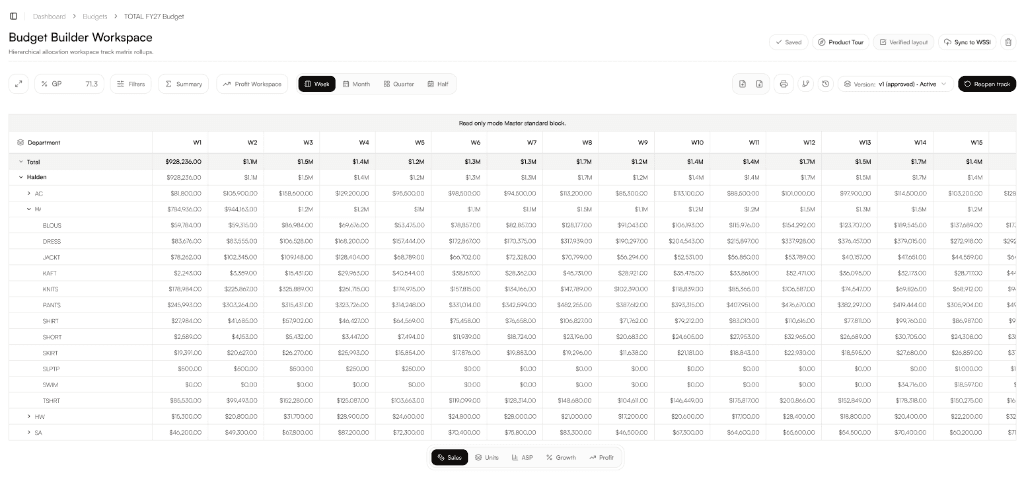
In merchmix, open-to-buy is not a sheet somebody rebuilds. It falls out of the WSSI, which is fed by the budget builder in core, so the ceiling on the buy traces back to the target finance signed off without anyone retyping it.
Because the WSSI updates from your live POS and ERP data, the OTB moves when the plan moves. Re-forecast on a Monday and the number the buyer is working to has already changed.
The range plan is where it gets spent, and it tracks OTB against the committed buy at style level, so a buyer can see what is left while they are building the range rather than after. Styles carry their status through the process, and the range plan is the gate before a purchase order is raised. atlas tracks OTB against actual purchases, which is how buying discipline gets measured rather than assumed.
Your team still decides what to buy. The platform makes sure the number they are deciding against is the real one.
See how open-to-buy runs inside MFP (WSSI) in merchmix.
See if this fits the way you already work.
Questions, answered.
What is open-to-buy?
Open-to-buy is how much more stock you can commit to for a given period without breaking the plan. It is calculated from where you plan to finish, what you plan to sell, what you are holding and what is already on order.
What is the open-to-buy formula?
OTB equals planned closing stock plus planned sales plus planned markdowns, minus opening stock, minus stock already on order. It is normally calculated at retail value, by category, by period.
Is open-to-buy calculated at cost or at retail?
Usually at retail, because it comes from a WSSI planned at retail. Buyers commit at cost, so the same OTB converts through your intake margin. An OTB of 120 at retail with a 60% intake margin is 48 at cost. Both are correct. Always say which one you mean.
What is the difference between OTB and a budget?
A budget is a target set in advance. Open-to-buy is what the weekly plan produces once that target meets what is actually happening. The budget is fixed for the year. The OTB moves every week.
What is the difference between open-to-buy and replenishment?
Open-to-buy is a budget: how much you can still commit to in a period, set by the plan. Replenishment tops up lines already in the range, usually to a minimum or a target weeks of cover. Open-to-buy decides how much you can buy. Replenishment decides when existing lines are reordered, and those reorders come out of the same open-to-buy.
What does a negative open-to-buy mean?
You are overbought. What you are holding plus what is on order already exceeds what the plan needs. There is no room to buy, and usually there is stock to cancel, delay or trade out of.
Who owns the open-to-buy?
The planner or merchandiser calculates it, the buyer spends it, and finance cares about it. It works when all three are reading the same number, which is more often the real problem than the arithmetic.
How often should open-to-buy be recalculated?
Every week, because four of its five inputs move every week. Most retailers rebuild it monthly, which is why the number a buyer is working to is usually out of date.
How does stock on order affect OTB?
Every open purchase order is open-to-buy already spent. It is normally the largest single deduction and the one most often missed, because the commitment was made months earlier.
Can you do open-to-buy in a spreadsheet?
Yes, and most retailers do. The arithmetic is simple. The problem is that it is only true on the day it is built, and the inputs move constantly, so buying decisions get made against a number that expired weeks ago.
Does having open-to-buy left mean you should spend it?
No. It is a ceiling, not a target. And it is only real if you can get the stock in and sold inside the window. An OTB you cannot land in time is not an OTB.
Signals matter while there is time to act.
Let us show you how merchmix keeps teams trading instead of firefighting.