Publish Date :
The Jacket Changed. The Product Photography Did Not
Forge’s approved specification and customer-facing assets need to describe the same product. A technically ready style can still reach launch with images from an earlier revision. Review the affected files and channel placements before treating product approval as publication readiness.
THE MERCHMIX DECISION / Forge
The garment is correct but two images are old
Forge’s approved specification and customer-facing assets need to describe the same product.
Independent worked retail example. Operational quantities, policies and outcomes are assumptions, not company data or measured Merchmix results. Financial amounts are in US dollars. Proposed actions remain subject to review.
The garment is correct but two images are old
| Asset | Review outcome |
|---|---|
| Front | Pocket layout outdated |
| Back | Pocket layout outdated |
| Fabric close-up | Verified still accurate |
The factory is assumed to have made the approved revision.
The factory is assumed to have made the approved revision.
THE KEY IDEA
Make the approved physical product and the published customer view agree before closing the launch handover.
Keep product readiness and channel readiness distinct
Forge connects the product’s specification, samples, approvals, assets and product-copy context. That gives the team a place to identify the accepted product revision. It does not establish that every downstream product page has received or published matching imagery.
This article concerns a cream utility jacket whose approved pocket layout changed before production. It is different from sending an outdated tech pack to the factory: assume the factory made the correct jacket and the mismatch is in the customer-facing image set.
Identify which images the change actually affects
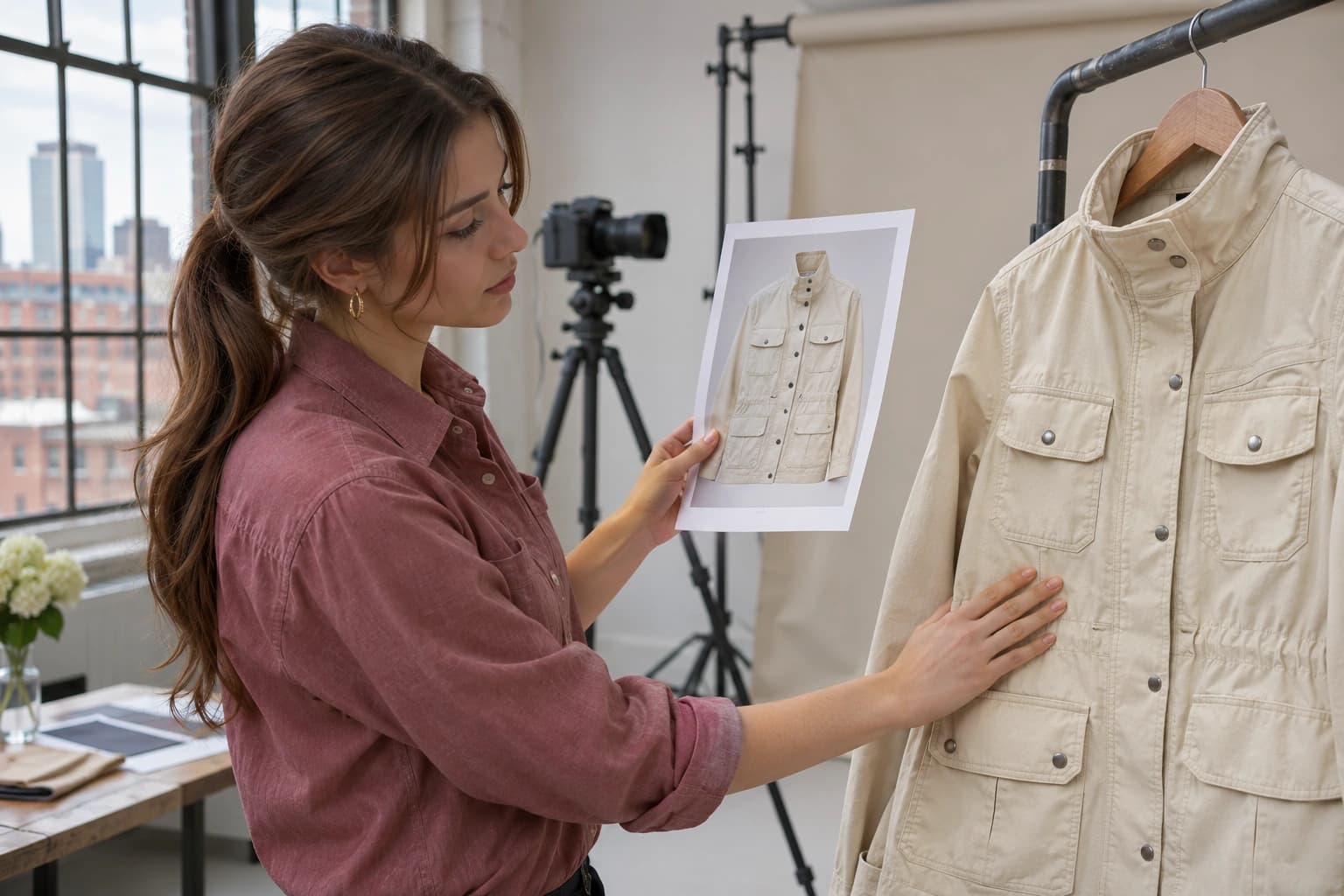
An independent style has three required images: front, back and a fabric close-up. At the chosen checkpoint, the front and back still show the earlier pocket layout. The fabric close-up remains accurate because the fabric and the photographed detail did not change.
Two assets therefore require correction, not all three automatically. The product owner must verify that scope against the real approved garment; a file date or a new revision number alone does not prove an image is accurate.
Separate two files from six placements
The retailer plans to use the image set on its own website and two marketplace storefronts. Correcting two files creates six affected placements: two files across three destinations. Those are distribution checks, not six distinct photography briefs.
Assume the creative team quotes $150 for each corrected image, making $300 production cost. Multiplying six placements by that production price would incorrectly show $900. Any channel upload or agency handling cost is outside this assumption and needs its own quote.
THE FIGURES BEHIND THE DECISION
| Scope | Count | Basis |
|---|---|---|
| Required image set | 3 | Front, back, fabric detail |
| Images to correct | 2 | Front and back only |
| Affected placements | 6 | Two files × three destinations |
| Image production | $300 | Two × $150 |
2 corrected files × 3 destinations = 6 placements. Photography is 2 × $150 = $300, not six photography fees.
Do not let the stock arrival settle the image question
Four hundred correct jackets are assumed received and usable at $40 goods cost, or $16,000. That stock can be physically ready while the product page remains inaccurate. Equally, corrected images do not confirm stock receipt or usable size availability.
The retailer should choose a controlled publication response appropriate to its customer promise. This example does not quantify return reductions, conversion improvements or legal outcomes from correcting the images. Those would require their own evidence.
Use Forge as the approved-product reference
The product owner confirms the current pocket layout and which assets remain valid. The creative owner creates the two corrected files against that accepted scope. Channel owners then verify the six affected placements against the actual product page, not only an upload confirmation.
Forge provides product and asset context; no automatic marketplace publishing or image-comparison engine is claimed. Preserve a clear record of the approved file and the destination checks through the retailer’s supported content process.
Close the loop at the customer view
The final check should compare the product the customer will receive with the images and description the customer sees. Confirm front, back and the retained fabric detail together, with the correct colourway and useful stock scope.
The result is one coherent release: the right garment, current approved assets and confirmed channel presentation. Product approval is an important input to that release, rather than proof that every placement is already correct.
BEFORE THE NEXT DECISION
- Product
Product lead; Confirm pocket layout and retained detail
- Assets
Creative lead; Approve two corrected files
- Placements
Channel owner; Verify six published placements
| Signal | Decision owner | Decision to review |
|---|---|---|
| Product | Product lead | Confirm pocket layout and retained detail |
| Assets | Creative lead | Approve two corrected files |
| Placements | Channel owner | Verify six published placements |
Common questions
Does every asset need a new photograph?
No. In this case only front and back changed; the fabric close-up is verified as still accurate.
Why are six placements not six photographs?
Two corrected files are used on three channel destinations.
What does the three-hundred-dollar example cover?
Two corrected images at an assumed $150 each, excluding channel handling and other costs.
Does Forge publish the marketplace images automatically?
No such capability is claimed. Channel owners confirm the actual published product view.
FROM THE ARTICLE TO YOUR OWN RETAIL PLAN
Review the decision.
See the workflow.
Bring your planning questions to a demo, or explore a proof of concept on your own data.