Educational guide
What is assortment planning?
The process of deciding which products to offer, in what breadth and depth, across stores and channels, so the range matches local demand without breaking the budget.
A plain-English guide to assortment planning: breadth vs depth, store clustering, and reconciling the range to open-to-buy.
10 min read · Updated 26 October 2026
In this guide
- Assortment planning turns money into a product list.
- Range and assortment answer different questions.
- Breadth and depth trade off directly.
- A worked assortment, in numbers.
- Clustering turns one plan into several.
- Seven steps from budget to shop floor.
- Assortment planning goes wrong in five ways.
- In merchmix, the assortment stays inside the money.
- Questions, answered
The basics
Assortment planning turns money into a product list.
Assortment planning is the process of deciding which products a retailer will offer in each store, cluster and channel for a season: how many options, at what depth, and how the mix varies by location, so the range meets local customer demand while staying inside financial and open-to-buy targets.
Every season a retailer has a finite amount of money and space, and a near-infinite number of products it could carry. Assortment planning is how that money and space get turned into a specific, deliberate list of choices: this many dresses, in these styles, at these price points, in this depth, sent to these stores. Done well, it puts the right products in front of the right customers and keeps stock working hard. Done badly, it spreads the budget too thin, over-buys the wrong options, and leaves best-sellers out of stock while slow lines pile up in the stockroom.
It sits between two other disciplines. Above it, merchandise financial planning sets the seasonal budget, margin and intake. Below it, buying and allocation execute the plan. Assortment planning is the bridge that converts a financial target into an actual product mix.
Terminology
Range and assortment answer different questions.
The two terms are often used interchangeably, but they answer different questions.
| Term | Question it answers | Output |
|---|---|---|
| Range planning | What products will we develop or buy this season? | The full set of styles, options and price points for the season. |
| Assortment planning | Who gets what, and how much? | The deployment of that range across stores, clusters and channels, at a planned depth. |
| Option / choice planning | How many distinct choices per category? | An option count per category, balanced to budget and space. |
In short: range planning is what do we make; assortment planning is who receives it and in what quantity. A single range can produce many different assortments: a flagship store and a small regional store draw from the same range but get very different assortments.
The core trade-off
Breadth and depth trade off directly.
Every assortment decision is a balance between two levers:
- Breadth
- Number of options / choices
- Depth
- Units bought per option
Breadth is variety: how many distinct choices a customer can pick from in a category. Depth is commitment: how many units you buy of each option. With a fixed budget, the two trade off directly: a wider assortment means less depth per option, and a deeper assortment means fewer options. Carry too much breadth and you spread thin, dilute availability and raise markdown risk; carry too little and you look narrow and miss customers. The art of assortment planning is finding the breadth-and-depth mix that maximises sell-through against the money available.
The right balance differs by category role. Core, continuity lines (basic tees, staple denim) reward depth: they sell predictably and rarely mark down. Fashion and trend lines reward breadth: you want more options to test newness, but shallow, so a miss costs little.
See it in numbers
A worked assortment, in numbers.
Here is a simplified womenswear season, showing how a category budget resolves into options and depth. The buy value is reconciled to the open-to-buy set in merchandise financial planning.
| Category | Role | Options | Avg depth (units) | Total units | Buy value |
|---|---|---|---|---|---|
| Core tops | Continuity | 12 | 1,800 | 21,600 | £216k |
| Fashion tops | Trend | 40 | 320 | 12,800 | £154k |
| Dresses | Trend | 28 | 450 | 12,600 | £214k |
| Denim | Core | 10 | 1,500 | 15,000 | £180k |
| Total | 90 | 62,000 | £764k |
Read across and the strategy is visible: core categories carry few options at high depth (12 core tops absorbing £216k), while fashion categories carry many options at low depth (40 fashion tops testing newness at 320 units each). The option count controls breadth; the depth column controls commitment. If the £764k buy value overshoots the open-to-buy, the planner pulls options or depth until it reconciles, which is the heart of the discipline.
Localisation
Clustering turns one plan into several.
A national assortment sent identically to every store wastes money. A large flagship and a small regional store have different space, footfall and customer profiles, so they should receive different assortments. Store clustering (also called grading) groups stores with similar characteristics so each group gets an assortment sized to its potential.
| Cluster | Profile | Options carried | Depth index |
|---|---|---|---|
| Grade A: Flagship | High footfall, large space | 90 (full range) | 130 |
| Grade B: Core | Mid-size, steady demand | 65 | 100 |
| Grade C: Compact | Small space, edited need | 40 | 70 |
Clustering turns one plan into several localised ones: the flagship gets the full 90-option range at high depth, while the compact store gets an edited 40 options at lower depth. This lifts availability where demand is strong and cuts overstock where it is weak, which is the single biggest efficiency lever in assortment planning, and the one hardest to run in a spreadsheet at scale.
How it runs
Seven steps from budget to shop floor.
- Set the financial frame.
- Take the seasonal budget, margin and open-to-buy from merchandise financial planning. This caps total options, units and buy value.
- Define category architecture and roles.
- Decide how the budget splits across categories and label each as core, fashion or continuity, which drives the breadth and depth mix.
- Plan breadth.
- Set an option (choice) count per category that fits the budget and available space.
- Plan depth.
- Assign planned units per option, weighting depth toward core lines and keeping fashion shallow.
- Cluster and localise.
- Group stores and size each cluster's assortment to its selling potential.
- Reconcile to OTB.
- Check the total buy value against open-to-buy and adjust options or depth until it balances.
- Hand off and trade.
- Pass the plan to buying and allocation, then track it in-season on the MFP (WSSI), editing as options and clusters over- or under-perform. Each approved option becomes a purchase order line, with the quantity, cost and delivery week coming from the plan, and the order value is checked against open-to-buy before it is raised.
Assortment planning, connected to your buy.
Plan breadth, depth and store clusters against live open-to-buy in one place.
Where it breaks
Assortment planning goes wrong in five ways.
- It lives in spreadsheets disconnected from the budget.
- When the assortment is not reconciled live to open-to-buy, teams commit buys that overshoot the plan and discover it too late.
- One assortment for every store.
- Without clustering, strong stores run out of best-sellers while weak stores drown in stock: the same range, wrongly deployed.
- Breadth creep.
- Every buyer wants more options; without a hard choice count the assortment widens, depth thins, availability drops and markdowns rise.
- No in-season feedback loop.
- The plan is set once and never revisited, so early sell-through signals from the WSSI never feed back into repeat buys or edits.
- Planning, buying and allocation in separate tools.
- The assortment plan, the purchase orders and the store allocation do not talk, so intent is lost in translation between systems.
In merchmix
In merchmix, the assortment stays inside the money.
core runs assortment and range planning as a connected part of the merchmix platform rather than a standalone spreadsheet. Breadth and depth are planned against live open-to-buy, so the buy value reconciles to the financial plan as you build it. Store clustering and grading localise the assortment automatically, and the plan flows straight into core plus for allocation and replenishment, while the WSSI feeds in-season performance back so you can edit options and depth against real demand.
The result is a single thread from budget to option to store: assortment decisions that stay inside the money, respect local demand, and reach the shop floor without being re-keyed between tools.
- Assortment planning software
- Connect option planning from target to purchase order. See the software
- What is a WSSI?
- How the weekly plan tracks stock and intake. Read the guide
- What is open to buy?
- The budget your assortment spends. Read the guide
Questions, answered.
How does an assortment plan turn into purchase orders?
The assortment plan sets how many options each category carries and how many units of each go to each store cluster. Once a style is approved, those units become purchase order lines: style, colour, size split, quantity, cost price and delivery week. Before the order is raised, its value is checked against open-to-buy for that category and week, so the buy stays inside the budget. In merchmix, an approved range creates the purchase orders for review, and the ERP stays the system of record.
What is option planning in retail?
Option planning decides how many options, meaning style and colour combinations, each category carries in a season, and for which stores. It works by attribute (category, price point, fabric, fit) and by store cluster, so an A-grade store might carry 90 options and a C-grade store 40. It sits between the budget, which sets the money, and the buy, which sets the units, and it is where breadth is fixed before depth is planned.
What is an assortment buying board?
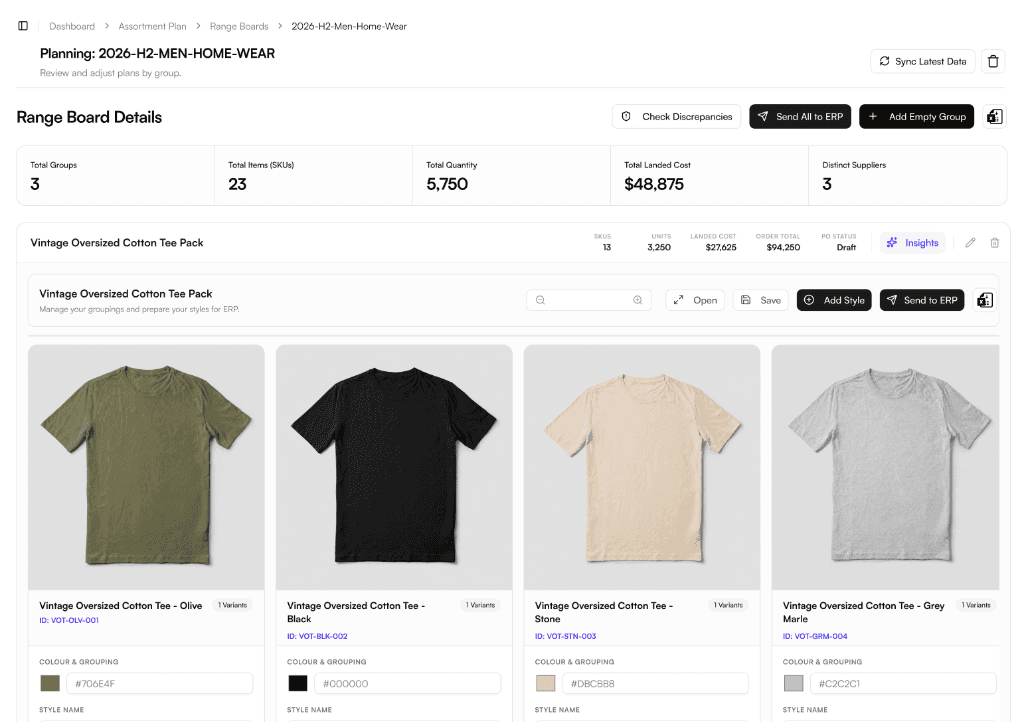
A buying board lays out the planned range visually, usually by category and price point, with each option shown as an image and its planned units and value. Buyers use it to see gaps, duplicates and balance across the range before committing to the buy, and to check that the total sits within open-to-buy. In merchmix, the range board stays linked to the plan, so moving an option on the board updates the numbers.
What is assortment planning?
Assortment planning is the process of deciding which products a retailer will offer in each store, cluster and channel for a season: how many options (breadth), how many units per option (depth), and how the mix varies by location, so the range meets local customer demand while staying inside merchandise financial and open-to-buy targets.
What is the difference between range planning and assortment planning?
Range planning decides the total set of products you will develop or buy for a season. Assortment planning decides how that range is deployed: which options go to which stores or clusters, and at what depth. Range planning is 'what do we make'; assortment planning is 'who gets what, and how much'.
What is breadth versus depth in an assortment?
Breadth is the number of distinct choices or options in a category (variety). Depth is the number of units bought per option (inventory commitment). A wide, shallow assortment carries many options in low quantities; a narrow, deep assortment carries fewer options in high quantities. Balancing the two against the open-to-buy budget is the core assortment decision.
How does assortment planning relate to open-to-buy and WSSI?
Merchandise financial planning and open-to-buy set the money available; assortment planning spends it as options and units; the WSSI then tracks how that plan trades week by week. A good assortment plan is reconciled to open-to-buy before commitment and feeds intake into the WSSI.
What is store clustering in assortment planning?
Store clustering (or grading) groups stores with similar demand, size, climate or customer profile so each group receives an assortment sized to its potential. It replaces a single national assortment with localised assortments, improving availability in strong stores and reducing overstock in weak ones.
Can you do assortment planning in Excel?
Yes, many teams start in Excel, but it breaks down at scale: reconciling breadth and depth to open-to-buy, clustering hundreds of stores, and keeping the plan in sync with buying and allocation becomes slow and error-prone. Purpose-built assortment planning connects the plan to financials, clustering and allocation in one place.
When should assortment planning happen?
Assortment planning runs after the merchandise financial plan sets the seasonal budget and category architecture, and before buying commits. It should be revisited in-season as trade data and the WSSI show which options and clusters are over- or under-performing.
What outputs does an assortment plan produce?
An assortment plan produces an option (choice) count by category, a planned depth per option, a total unit and value buy reconciled to open-to-buy, and a store-cluster grid showing which options each group of stores receives: the brief that buying and allocation then execute against.
Assortment planning, connected end to end.
From open-to-buy to store clusters to allocation: one plan, one source of truth.