Blog
Thinking about retail, out loud.
Shorter than a guide, more opinionated than a press release, written by people who have run an MFP (WSSI). Each post takes a position on how the trade should be run and expects to be argued with. Nothing here is an announcement in disguise.
Each post makes a case.
Newest first, dated when published, with the topics every one carries. Open the one that disagrees with you.
What an AI Agent Should Never Do Without Approval
Yukti needs an explicit authority boundary for spend, price and supplier commitments, even when the recommendation is commercially plausible.

Broken Size Runs: Why Styles Stop Selling Before They Sell Out
A style can retain plenty of stock while its most-needed sizes have almost no cover. Repair the run only when matching supply can arrive within the selling window.

Changing an Order After It's Placed: Keeping Suppliers in the Loop
An order change needs a visible comparison between the current commitment, the requested revision and what the supplier can actually accept.

Why Christmas Re-Forecasts Come Too Late
A Christmas reforecast is useful while there is still time to change an intake commitment, rather than only explaining the stock left after the peak.

Keeping Continuity Lines in Stock Without Overbuying Basics
Continuity stock needs a demand-based boundary that includes usable incoming units, rather than a repeat buy justified only because the product is a basic.

Why Planners Won't Give Up Excel (and Don't Have To)
Excel can remain useful for analysis when the return to Core has a defined scope, current baseline and a review of what changed.

The Overlap Hiding in Your Range
Near-duplicate options deserve a customer-role and availability test before the next range commits stock to all of them again.

Why Premium Brands Track Full-Price Sell-Through Weekly
Full-price sell-through shows how much of a defined stock cohort sells at its intended price, while a separate sales-share measure describes the price mix of units sold.

When Replenishment Empties the Warehouse
A warehouse reserve needs protection across the whole replenishment queue, because individually reasonable store requests can compete for the same units.

Standing Orders for Replenishment Lines
A standing purchasing arrangement can simplify repeat buying only when the agreement ceiling, released orders and physical receipts remain clearly separated.

Aged Stock: Mark Down, Transfer or Write Off?
Aged inventory needs a comparison of feasible recovery, route costs and residual stock, rather than an automatic discount or transfer based on age alone.

Connecting POS, ERP and Ecommerce to One Plan
Planning integrations need agreed owners, timestamps and transaction meanings, so the same sale is not counted twice and future stock is not treated as usable today.

Showrooms Out, Warehouse Full: Electronics Stock Distribution
Electronics allocation needs the exact usable model at the showroom before demand occurs, rather than a reassuring total held elsewhere in the network.

Enterprise vs Mid-Market Planning Tools: The Real Total Cost
Compare planning software on a common delivery scope, retailer effort and time horizon, rather than using the subscription fee as the complete cost.

Markdown Approvals That Slow Everything Down
A markdown approval needs the product, price, selling dates and financial consequence in one review, followed by confirmation that the intended price is actually active.

What Data You Need to Start a Planning POC
A planning POC needs a small, defined data pack whose product keys, periods, stock states, commitments and budget basis can be reconciled.

How to Run a Retail Planning Software Proof of Concept
A retail planning POC should prove a small set of real decisions against agreed inputs, expected calculations and clear acceptance criteria.

Small Fabric Changes, Big Margin Hits
A fabric change can raise garment cost even when the price per metre stays the same, because usable width and consumption determine how much material each unit needs.

Store Refits and Closures: Planning Stock Around Them
A store refit or closure needs a dated run-down, supported receiving destinations and a separate decision on incoming commitments that would arrive while the site cannot trade.

Wholesale and Retail in One Plan
Wholesale and retail planning needs one stock basis, with firm commitments and the remaining retail forecast reconciled so booked customer demand is counted once.

Activewear: Planning Newness and Continuity Together
Activewear merchandise planning needs room for new colours without underfunding the permanent lines customers return to buy.

The Allocator's Morning: Exceptions First
A retail allocator needs to find the proposals that can become useful stock movements today, not simply the biggest shortage on a list.

Black Friday Is Won in the Two Weeks Before It
Black Friday inventory planning needs a release decision before the offer begins: usable stock, confirmed intake, matching sizes, approved prices and a post-event plan.

The Black Friday Margin Trap
Black Friday margin depends on what the offer adds after the price reduction and event costs, not just how many units sell.

Department Stores: Concessions, Owned Stock and One Plan
Department store planning needs a shared customer view without treating concession turnover as if it were all retailer-owned revenue and stock.

Ecommerce Teams Advertising Products That Are Out of Stock
Ecommerce inventory should inform which product variant a campaign offers, not just whether any stock remains in the style.

Five Inventory Questions Every Retail CFO Should Ask
A retail CFO needs to know what stock has cost, what future orders still commit and which assumptions could make that investment harder to recover.

Footwear: Why Size Availability Decides Everything
Footwear merchandise planning has to serve the size a customer needs, not merely keep the style in stock.

Grocery and FMCG: Replenishment Without Waste
Grocery replenishment needs to match the quantity customers can buy within the stock’s usable selling life, not just the next delivery slot.

Merchandiser, Planner, Buyer, Allocator: Who Owns Which Decision?
The difference between a merchandise planner and buyer becomes useful when the retailer defines which decisions each role owns.

What a Retail CEO Needs on One Page
A retail CEO dashboard should make the next business decision clearer, not compress every report into smaller tiles.

What Buyers Need From Planning Software
Software for retail buyers should connect the proposed product depth with the money and supplier conditions required to buy it.

The Eight Numbers a Trade Meeting Actually Needs
A trade meeting needs a small set of connected numbers that leads to a decision.

Electronics Retail: When a Product Generation Ages Into the Outlet
A new generation changes the old model’s selling opportunity without removing the old stock commitment.

Why Teams Measure Forecast Accuracy Wrong
A correct group total can conceal two wrong local forecasts.

Measuring the Sales You Never Made
Recorded sales cannot reveal all the demand a missing size might have served.

Nearshoring or Offshore: Speed or Cost?
A faster supplier is worth more only when its extra cost is justified by an opportunity the retailer can use.

Pharmacy Retail: Planning Cold-and-Flu and Sun-Care Seasons
A seasonal plan must respect the usable selling window as well as expected demand.

Stop Reading Every Line: Exception Reporting for Planners
An exception queue should rank decisions that can still change an outcome, not simply the largest numbers.

Returns: The Stock You Forgot to Plan
A return forecast is not stock available to sell today.

What Moved Gross Margin This Week?
A changed margin needs an explanation of volume, mix, realised price and cost, not only a percentage.

Which Stores Earn Their Stock?
A store’s sales total does not show how productively it uses stock investment.

Comparing Supplier Quotes Without the Spreadsheet Chase
The lowest unit quote is not necessarily the lowest comparable commitment.

Why Development Calendars Slip, and What It Costs the Range
A late approval matters when it delays the next dependent activity, not simply because it appears red on a calendar.

Landed Cost: The Number Missing From Your Margin Plan
A factory quote can fit the budget while the cost of making stock usable exceeds it.

Partial Shipments: Allocating What Arrived, Re-Planning What Didn't
A partial delivery requires a new usable-stock decision, not an allocation of the original order total.

PLM for Growing Brands: What You Need First
A growing brand first needs a trustworthy product record and clear decision ownership, not every possible PLM feature at once.

When Product Development and Planning Don't Talk
A development candidate is not yet an affordable buying commitment.

Supplier Lead Times That Keep Slipping
A supplier’s latest promised date is not the same as evidence of its lead-time reliability.

Supplier Scorecards That Change Behaviour
A supplier scorecard changes behaviour when its definitions lead to a specific improvement decision.

Tech Packs That Go Wrong at the Factory
A factory can follow its instructions correctly and still make the wrong garment if those instructions describe an old revision.

Too Many Sample Rounds
An extra sample round should answer a new technical question, not repeat an unresolved instruction.

Getting the Core and Fashion Colour Split Wrong
A colour split is a stock commitment, not just a creative preference.

Discount Rate Creep: Spotting It Before the Half-Year Results
Rising sales can hide a falling realised price against ticket.

New Products With No History: Where the First Forecast Comes From
A new product needs a reasoned first forecast rather than a copied sales target.

Outlet and Archive Sales: Planning the Exit Before You Buy
An exit route belongs in the buying decision before stock becomes old.

Pre-Packs That Don't Match How Stores Sell
A pack can be efficient to handle and unsuitable to sell.

Promotions and Markdowns Need Separate Budgets
A promotional discount and a stock-exit reduction can reduce the same sales total for different reasons.

Why Sending Everything to Stores Up Front Backfires
An initial allocation can remove the flexibility the next trading weeks need.

Store Grades Nobody Has Reviewed in Three Years
A store grade is a planning assumption that needs fresh evidence.

Testing an Allocation Before the Stock Leaves the Warehouse
An allocation comparison is useful while its quantities can still change.

When to Retire a Continuity Style
A continuity style needs an exit decision when its ongoing role no longer supports the stock commitment.

Carry-Over or Cut? Deciding Which Styles Earn Another Season
A returning style should earn its next commitment through the quality of its selling, not familiarity.

When Faster Drops Start Hurting Margin
Newness creates an opportunity only if each drop has enough useful depth and time to sell.

Multi-Brand Groups: One Group View Without One Way of Planning
A group total is useful only when its brands agree what the numbers mean.

Online and Stores Planned Separately: Where the Stock Goes Wrong
One shared buy can miss both channels if its size mix reflects neither customer.

When Sales Run Ahead: Chasing Stock Without Blowing the Budget
A winning product creates a buying question, not permission to spend without a limit.

When Sales Run Behind: Which Orders to Cut First
A lower forecast identifies exposure; supplier terms determine which commitment can actually change.

Same Range in Every Store: Why It Underperforms
Localising a range means changing what a store offers, not only how much stock it receives.

Shifted Holidays and 53-Week Years: Comparing Like With Like
A calendar mismatch can look like demand growth before a single customer has changed behaviour.

Too Many Options, Not Enough Sizes
A wide range can spend the budget before it gives a key size enough local depth.

Why Range Reviews Rarely Change the Buy
A range meeting changes the buy only when the pictures stay connected to quantities and money.

AI-Native or Bolt-On? Questions to Ask a Planning Vendor
The useful test of a planning agent is whether a retailer can trace its recommendation from a defined stock position to a bounded decision.

Boots Bets on K-Wellness: How to Buy Into a Trend Before It Peaks
A popular trend deserves a buying test before it deserves a large repeat order.

The Do-Not-Replenish Call: The Margin Decision Nobody Makes
A repeat order can be the wrong response even when a product is still selling.

The Hidden Cost of an Unprotected Planning Spreadsheet
A buying plan becomes risky when a changed input and an unchanged subtotal can travel together unnoticed.

A Marathon Win Can Empty Your Shelves: Planning for a Hero Product Spike
A race result can create attention before a retailer has evidence of repeatable demand or even a product available to sell.

Margin Looks Fine. So Why Is So Much Cash Tied Up in Stock?
A strong margin percentage can coexist with a heavy inventory investment.

Singles Day, Black Friday, Boxing Day: Planning Stock Across Three Peaks
A strong first sale can leave a retailer short of the products it wanted to sell later at a higher price.

Sports Direct Enters Kenya: Allocating Stock to a Market With No Sales History
A new market needs an opening stock hypothesis, not a borrowed forecast presented as local history.

Stock That Arrives Early Costs as Much as Stock That Arrives Late
An early receipt can commit cash and space before it supports the intended demand.

Wild Weather and the Bottom Line: Is Weather in Your Forecast?
Weather should change a retail assumption only when the team can explain the affected products, places and weeks.

Sales Up, Outlook Down: What a.k.a. Brands Shows About Growth and Margin
Growing sales do not remove the cost of opening stores or changing a distribution network.

Cautious Christmas Shoppers: Is Your Stock in the Right Products?
A cautious Christmas customer does not necessarily want less of every product; the mix of value, gifts and discretionary purchases may change.

What David Jones' Collapse Teaches Department Stores About Stock and Space
A department store needs to know which stock earns the space it occupies, while keeping store costs and ownership arrangements visible.

Hugo Boss Cuts Its Outlook: How Premium Brands Respond When Demand Softens Mid-Season
A weaker in-season outlook creates a commitment question before it creates a new buying allowance.

JD Sports Hits 98% On-Shelf Availability: Why the Right Sizes Matter Most
Footwear availability depends on the size a customer requests and whether that pair can reach the selling floor in time.

Lefties Lands in the UK: How Can Mid-Market Fashion Compete With Inditex Speed?
A mid-market retailer needs a relevant range and dependable depth in the products its customers choose.

How Did Better Stock Flow Help M&S Fashion Grow 17.5%?
Better stock flow helps when demand exists but the right products and sizes are not available to sell.

Memory Chip Costs Are Rising: What Should Electronics Retailers Re-Plan?
A supplier cost increase changes the margin and buying capacity of the affected products, even before a retail price changes.

De Minimis Has Ended: How Should Australian Brands Plan US Stock?
A local US fulfilment base changes where a brand commits stock, not just the cost of sending an order.

Planning Software and ERP: Why You Need Both
Understand ERP vs merchandise planning. Connect Merchmix Core budgets, MFP/WSSI and buying decisions with Horizon or your existing ERP’s operational record.

Why Is Discounting Eating Into Primark's Profit?
Why discounting pressures Primark’s profit, how a 15% price cut changes the units needed, and how Merchmix Core and Atlas help retailers review slow sellers.

A Rate Rise Before Christmas: Should Retailers Re-Forecast Now?
A rate rise is a reason to test the Christmas plan, not to cut every category by the same percentage.

178 Tariff Exclusions Expire on 9 November: Is Your Costing Ready to Change Fast?
Update, 14 November 2026: USTR extended the 178 exclusions through 9 January 2027. Review the current notice before changing buying costs.

Shopify's US$119bn Quarter: When Do Growing Brands Outgrow Spreadsheets?
A growing brand outgrows spreadsheets when separate channel plans repeatedly compete for the same stock or disagree about commitments.

Shopping Agents Are Coming: Is Your Stock Data Ready?
An agent cannot make a dependable purchase decision from stock data that mixes physical, reserved and incoming quantities.

Black Friday Now Starts in Mid-November: How Do You Plan a Three-Week Sale?
A longer promotional calendar needs weekly decisions about stock, price and the demand left to serve.

How V-Mart Cut Seven Days of Inventory With a Better Allocation Model
Better allocation puts existing stock where demand is strongest, but moving units does not instantly reduce total inventory.

Walmart Lets Shoppers Approve What Their AI Buys. Planning Should Work the Same Way.
An agent proposal is useful when the person responsible can see its scope, consequence and permission before an action runs.

Wayfair Grows in a Sluggish Home Market: Winning Share Without Overstock
Home-category growth needs a stock plan that respects demand, lead times and physical capacity.

Woolworths' Promotion-Led Growth: Planning Promotions Against Stock
A promotion needs an incremental-demand assumption and a stock plan for the weeks before and after the event.

What Zalando's Sneaker Discounts Say About Category Depth
A category can grow while carrying more depth than its remaining selling window can absorb at the intended price.

Can PUMA's Inventory Reset Help It Move Away from Discounting?
PUMA’s inventory reset puts buying and distribution discipline in focus. Explore the stock, demand and discounting decisions through Merchmix Core, Core Plus and Atlas.

Why Is Under Armour’s Sales Decline Pushing It to Cut Its Product Range?
Under Armour’s sharper-portfolio strategy raises questions about assortment, full-price demand and stock depth. Explore the planning response with Merchmix Core, Atlas and Core Plus.

Retail Supplier Collaboration: Why Late Updates Cost You Stock
See how Merchmix Beacon supports earlier supplier collaboration when a knitwear order faces a partial supply shortfall and an alternative-material decision has a deadline.

What Can Retailers Learn from Target's Costly Markdowns and Order Cancellations?
Target’s 2026 margin improvement provides a lesson in earlier markdown and cancellation costs. Explore connected buying, OTB and supplier decisions with Merchmix Core and Beacon.

Retail Markdown Planning: The Cost of Discounting Too Late
See the cost of delaying retail markdown planning in Merchmix Core, with a worked jacket example linking cover, selling time, price, gross margin and approval.

Why Are Lululemon's Sales Falling, and Is Its Product Strategy Keeping Up?
Lululemon’s Q2 2026 decline puts product relevance and in-season response in focus. Explore the planning lessons through Merchmix Core, Core Plus and Yukti.

Fashion Product Development: Connecting Design, Costing and Approvals Through PLM
Connect fashion product development through Merchmix Forge: follow a blazer fabric change through the BOM, cost assumptions, sample checks and revision approval.

Retail Analytics: The Metrics That Show Inventory Risk Early
Read sell-through, stock on hand, weeks of cover and sales performance together in Merchmix Atlas to identify inventory risks before the next stock decision.

Purchase Order Management: The Visibility Gap Between Buying and Delivery
See how Merchmix Stock Orders, Core and Beacon support purchase order management, from ordered quantities and expected dates to supplier responses and receipt checks.

Why Did Old Navy's Summer Collection Miss the Mark?
Old Navy’s Q2 2026 result raises questions about seasonal assortment and demand. Explore the planning lessons with Merchmix Core, Core Plus and Yukti.

Merchandise Financial Planning: What Happens When Budgets and Buying Don't Match
Connect merchandise financial planning with buying in Merchmix Core. See Budget Builder, Profit Workspace and the stock effect of a lower sales outlook.

Inventory Forecasting: Why Historical Sales Alone Aren't Enough
See how Merchmix Core’s MFP/WSSI connects inventory forecasting with availability, seasonal demand, current stock and incoming orders.

Retail Stock Replenishment: Keeping Best-Sellers Available Without Overbuying
Review retail stock replenishment in Merchmix Core Plus with refill models, DC guardrails, incoming supply and Yukti.

Multi-Store Inventory Management: When One Store Has Too Much and Another Is Running Short
Use Merchmix Core Plus to review store demand, allocation, stock transfers and incoming supply before rebalancing inventory.

Retail Inventory Management: Why Stores End Up Overstocked and Out of Stock
Review retail inventory management in Merchmix Core, Core Plus and Yukti, connecting MFP/WSSI, store stock and allocation decisions.

Retail size curves explained: how to set, review and correct them without overbuying
How to set, review and correct size curves by category and store, so each store gets the sizes it sells without overbuying the ends of the curve.

What Agentic AI Means for Retail Teams in 2026

Demand Forecasting Isn’t Broken. Retail Is Just Using It Wrong.

Why Weekly Trade Meetings Need Better Systems, Not More Spreadsheets

The New Constraint in Retail Isn’t Demand. It’s the Ability to Capture It

How AI Is Transforming Retail Fulfillment in 2026

Enhancing Inventory Visibility: The Retail Shift from Data to Decisions

AI Can Spot the Trend. The Hard Part Is Acting on It

Why Make-to-Stock Still Wins: Key Advantages of MTS in Modern Retail

4 Retail Operations You Must Automate to Save Your Margins in 2026

Top 10 Inventory KPIs Every Retailer Should Track

How AI Improves Retail Forecasting and Demand Planning

Getting Ahead in a Visual Merchandising World

Dead Stock in Retail: Causes, Costs, and How to Fix It

From Early-Stage to Market Leader: A System That Grows with You

Case Study - How Smarter AI Forecasting Helped a Retail Brand Regain Inventory Control

Overstocking in Retail: Causes, Problems, and How to Fix Them

How retailers reduce stockouts: forecasting, replenishment and allocation

From Guesswork to Growth: How Inventory Management Software Improves Forecasting and Planning

Case Study: How Merchmix Helped Firamae Grow Smart with Data-Based Predictions

Why Retailers Need Sales & Stock Forecasting Software to Stay Competitive in 2026

Addressing Procurement Lead Time Challenges: Best Practices for Inventory Control & Stability
Procurement lead-time risk is the gap between when stock is needed and when usable stock is expected to arrive. Merchmix Beacon gives supplier commitments a shared record, while Core brings the expected intake into MFP/WSSI so the buyer can review the stock consequence.
Balancing Stock Levels: How to Use Safety Stock in Your Forecasting Strategy
Safety stock is a buffer for demand or supply uncertainty, not a substitute for a realistic forecast. Merchmix Core connects the demand and intake assumptions; Core Plus supports the allocation and replenishment decisions that determine where available stock is held.

Sales & Operations Planning Metrics That Matter: Key Performance Indicators for Effectiveness
Sales and operations measures are useful when they connect a delivery outcome with its stock and trading consequence. Merchmix Atlas supports scoped reporting, while Beacon supplies order and supplier-response context; neither removes the need to define the measure first.

Creating a Lean Supply Chain: Reducing Waste and Maximising Efficiency
A lean retail supply chain reduces work and stock movement that do not improve the customer outcome. For Merchmix users, the useful starting point is a repeated planning or stock-handling decision, not a general promise to run the whole business with less inventory.

The Financial Implications of Poor Inventory Management in E-Commerce: A Cost Analysis
Poor ecommerce inventory decisions can tie up cash while leaving advertised products unavailable. The financial review needs to separate inventory value, holding expense and contribution at risk; Merchmix Core and Atlas provide planning and reporting context for that discussion.

Assessing the Financial Implications of Excess Inventory: A Quantitative Analysis
Excess inventory has several financial effects, and they should not be collapsed into one loss figure. Merchmix Core supports the sales, stock and intake plan; Atlas supports the reporting context needed to review the assumptions behind a stock-cost calculation.

AI in SKU Rationalisation: Streamlining Inventory by Identifying High-Impact Products
SKU rationalisation should identify which options earn their place, not simply reduce the product count. Merchmix Core supports range and option planning, while Atlas provides reporting context for reviewing sales, stock and margin across a consistent merchandise scope.

Proactive Tactics for Managing Backorders in Retail Demand Planning
A backorder concerns customer demand awaiting fulfilment, not just a low stock balance. Merchmix Core and Beacon help the team review planning assumptions and supplier commitments, while the customer-order system remains the source for what has actually been promised.

Pre-season inventory planning: how to prepare for market swings
Pre-season inventory planning decides what to buy, how much to commit and when stock should become available. Merchmix Core connects range planning, budgets and MFP/WSSI so the opening buy can be reviewed against the intended selling and closing-stock position.

Forecasting
Common demand forecasting mistakes, and how to avoid them

Demand planning and inventory management: how they connect

Topics follow the writing.
Counted from the posts themselves. Nothing is listed with nothing underneath it, so the shape of the list is the shape of what got published.
- Retail insights119
- Forecasting1
- 30
Longer answers sit elsewhere.
A guide explains one term end to end. What’s new lists what shipped, dated. Press keeps the announcements. This page is where we think in front of you, and change our minds in public when the numbers say so.
merchmix is retail merchandising and supply chain planning software. Each part has its own page.
- core: merchandise planning. MFP (WSSI), OTB, range and option plans.
- core plus: allocation, replenishment and transfers by store and size.
- atlas: retail analytics and the weekly trade view.
- yukti: rebalances stock, raises replenishment and cuts the PO, for your approval.
- horizon: the retail ERP, or connect your own.
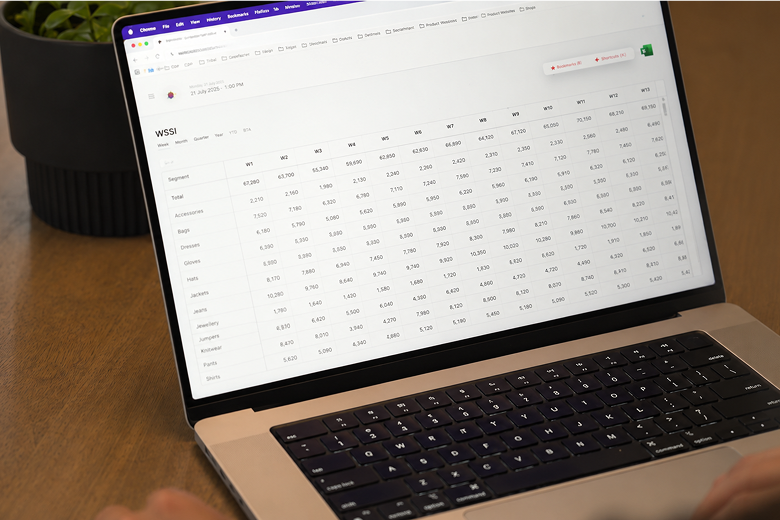
| Week | Sales LY | Sales TY | Var % | Intake | Markdown | Stock close | Cover |
|---|---|---|---|---|---|---|---|
| W31 | 184 | 197 | +7.1% | 230 | 22 | 1,131 | 5.6 |
| W32 | 191 | 204 | +6.8% | 225 | 24 | 1,128 | 5.5 |
| W33 | 210 | 198 | -5.7% | 240 | 27 | 1,143 | 5.6 |
| W34 | 205 | 196 | -4.4% | 215 | 25 | 1,137 | 5.4 |
| W35 | 188 | 208 | +10.6% | 250 | 23 | 1,156 | 5.2 |
| W36 | 192 | 214 | +11.5% | 235 | 26 | 1,151 | 5.0 |
| W37 | 199 | 222 | +11.6% | 260 | 25 | 1,164 | 5.0 |
| W38 | 204 | 231 | +13.2% | 250 | 27 | 1,156 | 4.8 |
| W39 | 212 | 236 | +11.3% | 270 | 28 | 1,162 | 4.7 |
| W40 | 218 | 240 | +10.1% | 265 | 28 | 1,159 | 4.6 |
| W41 | 226 | 249 | +10.2% | 285 | 30 | 1,165 | 4.5 |
| W42 | 231 | 254 | +10.0% | 280 | 30 | 1,161 | 4.3 |
| W43 | 240 | 262 | +9.2% | 290 | 31 | 1,168 | 4.2 |
Questions, answered.
How often do you publish?
When someone has something worth saying. No schedule is promised, so none is missed.
Who writes these?
People who have run an MFP (WSSI). The opinions are their own.
Where are the longer explainers?
In the guides, one term per guide. A post argues; a guide explains.
How does merchmix turn a forecast into an action?
The forecast feeds the plan. When sales run ahead or behind, yukti proposes the move: a buy, an allocation, a replenishment order or a transfer, with the stock and margin it affects. You approve it, and it is written back to the ERP, which stays the system of record.
Is merchmix supply chain software?
It covers the planning side of the retail supply chain: what to buy, how much, where it goes and when it is topped up. Your ERP stays the system of record.
Talking to us beats another article.
1-hour demo with sales and product. Free 6-week POC on your own data, no contract. Either gets you further than another article.